Showing posts with label Western Channel & South East Falmouth & Wight-Barfleur Extension (MCZ verification) CEND0312b. Show all posts

Tuesday, 28 February 2012

Farewell to the night shift!

Today was our last night shift of the survey and we have been busy taking the last video tows at the Wight-Barfleur Extension site. This site has been recommended as an MCZ by the Balanced Seas Regional Project for subtidal mixed sediments, subtidal coarse sediments and subtidal sands and gravels (see the Balanced Seas Final report). 

It has been a really interesting site to video as there are lots of exciting and colourful animals living on the cobbles, boulders and bedrock. Some areas are overrun by brittlestars of several different species, whilst some areas have none.
 
 
Brittlestar bed, including the Common brittlestar, Ophiothrix fragilis (we also saw the black brittlestar, Ophiocomina nigra

Below you can see some more examples of the fantastic invertebrates that we have spotted this morning...
 
 Dahlia anemone with brittlestars and sponges


Common sunstar (Crossaster papposus) with Dead Men's Fingers, sponges and a Queen scallop
 
Potato crisp bryozoan (Pentapora foliacea)
 
There are also a lot of sponges growing at this site and they are amazingly diverse in shape, colour, size and form. Below you can see an example of the golf ball sponge and the yellow hedgehog sponge.
 
 Golf ball sponge (Tethya citrina)
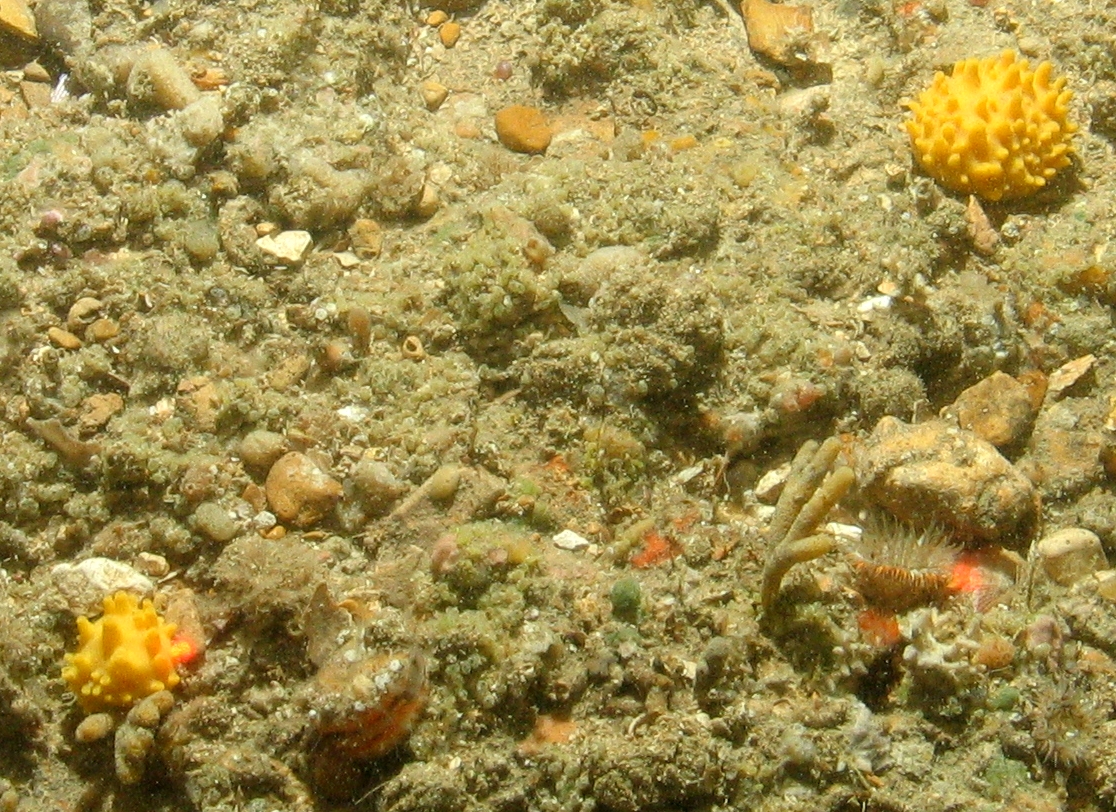
Yellow hedgehog sponge (Polymastia boletiformis)

So, the only challenge now remaining for us is to get out of the habit of eating breakfast at midnight, lunch at 4am, a snack at 7:30am and dinner at midday! 

At the end of our shift we will start steaming back to Lowestoft where we will be getting off. The staff and crew of the Cefas Endeavour will, however, continue survey work in the North Sea to support the MCZ Project.

Huge thanks go to the crew and Cefas colleagues who have made our stay on Endeavour such a brilliant experience.


Monday, 27 February 2012

Test yourself!

A quick mid-shift posting to let you know of a chance to test your marine knowledge.  Our partners Cefas have posted a plankton quiz on their blog "It's life Jim, but not as we know it". 

Match the 5 planktonic larvae with their adult forms - answers will come tomorrow.  No time for postcards - just a warm feeling for getting the right answers!

planktonic larvae - gone on, try your hand at identification
Take up the challenge on the Cefas blog.

Sunday, 26 February 2012

Little did they know...

The Nightshift (midnight to noon) went to bed thinking that at the start of their shift we would be on passage east towards an additional site south of the Isle of Wight (so called 'Wight-Barfleur Extension, of which more in a future post).
Filling in the gap - the white triangle

Since then our plans have changed and we are now gathering multibeam echosounder data for an area of the Western Channel rMCZ for which we don't have detailed data.  The multibeam data provides an acurate picture of the shape of the seabed, but the 'backscatter' of the echoes can be further analysed to give an indication of what the seabed type is.  This can then the confirmed ("ground-truthed") by the camera and grab samples that we've already taken.


Indicative survey lines - there are really 30+ lines
The process of collecting this full-coverage multibeam data involved steaming along a series of parallel lines 300m apart.  The map on the right gives an  idea of the lines we are following - but in reality there will be over 30 lines.  It will take approximately 20 hours to complete this piece of work.  It keeps the helmsman busy as he steers a 3000 tonne, 78m ship within metres of a pre-determined line, but for the science staff its not the most exciting aspect of cruise...


Data acquisition
Two echo-sounder systems working at different frequencies are being run at the same time.  Between them they generate about 400mb of data per hour, which means there is a lot of processing work to be done to produce the final images.  To get accurate results a number of additional factors have to be compensated for: sound velocity through the water, ships heading, tidal height, and ships motion.  


Ultimately, the processed data will yield a detailed seabed image.  The example below shows an area north of Anglesey.
Drumlins, north of Anglesey

Saturday, 25 February 2012

Last night shift at Western Channel

Having arrived back at Western Channel rMCZ yesterday, the day shift began where we all left off on (a very choppy) Thursday. The night shift took over at midnight and have been working like a well oiled (and slightly bleary eyed) machine through the night to get as many stations as possible sampled. Although the site is a large one, we are hoping to be finished with the sampling by midnight tonight and then steaming off to the next one! The next part of the trip is being planned at the moment but we should be heading somewhere close to the Isle of Wight to continue gathering important data for the MCZ project.

During the night we have taken videos of a shelly, sandy, gravelly seabed with interesting ripple features.
On this type of ground there aren't many animals to be seen living on top of the sediment. When taking grabs of these areas we did however find a good example of the crab species Eurynome spinosa (amongst other things) which you can see below, checking himself out in the ID book. The communities living within the sediment will be analysed by experts when we get back.

When moving across the site we found harder ground with cobbles and boulders and saw some exciting invertebrate life which we also sampled a bit of in the grabs. In the photograph below you can see Devonshire cup corals (a close up picture also below), Dead men's fingers, Anemones (a close up picture also below) and Serpulid worms all living on a single cobble!


Close up of Devonshire cup coral


Close up of anemone (tentacles in) living on shell fragment

We're now looking forward to seeing what the next shift has to offer!

Friday, 24 February 2012

Falmouth farewell

The decision to head north from the Western Channel to the South East of Falmouth rMCZ turned out to be a winner.  The sea was significantly calmer and the boat was able to work round the clock.  In fact as I write this we're now back at Western Channel (still a bit 'swelly' but not too bad) having completed the Falmouth site completely.  The forecast looks good for the next few days so we should be busy.

The last post on the blog highlighted some of the life seen on camera. The grabs too continue to turn up interesting species although there's not time during the survey to necessarily identify them fully.  That will happen when the samples are processed.

Goby

Amphipods

Artica Islandica shell from SE Falmouth


Nut crab

Circomphalus casina (with the ridges) and Acteon tornatilis technically a sea slug

Thursday, 23 February 2012

Cornish detour

Late in the evening we arrived to the site South-east of Falmouth, where the sea was thankfully calmer. This site has been recommended as an MCZ for subtidal coarse sediment and subtidal sand (see Finding Sanctuary's Final Report).

We've started our shift doing video camera tows to find out more about the sediment and select the stations where we could collect grab samples of sediment.

Early in the morning we were joined once again by a pod of 15 to 20 common dolphins, which swam alongside the ship for a while.

On the videos we've taken today we've seen quite a few exciting marine animals, including several lesser spotted dogfish, Atlantic mackerel, Atlantic horse mackerel, smelt, dragonet, thick back sole, monkfish, gurnard, and an octopus! You can see a short video of the octopus below. Enjoy!

Atlantic mackerel (in blue), Scomber scombrus, amongst other fish (Atlantic horse mackerel and smelt)


Octopus from JNCC on Vimeo.

Weather diversion

Our site in the Western Channel is very exposed to weather coming from the southwest which is just what we got earlier today (or yesterday).  By lunchtime, the conditions got too strong for safe working - the risk is when deploying and recovering the grab/sledge.   Always have a plan B - in our case it was to steam north to the rMCZ at South East of Falmouth.  Closer inshore the swell wasn't as bad and we could work safely.  We'll sample this relatively small rMCZ before returning to Western Channel later in the week when the weather should be better.

Preparing to recover the camera sledge as the waves are picking up

Once the sledge leaves the water it can start to swing as the boat rolls.
Endeavour's crew are well practised and got the sledge aboard safely, but this was the last tow for the moment.

The view from the bridge.

When we were able to sample with the Hamon grab, many of the station yielded 8-10 litres of  this 'biogenic' sand (made by animal processes rather than geological ones).  Its made of shells and urchin spines.
 The English Channel is a busy place and we've seen a lot more shipping here than at the sites in the Celtic Sea. One edge of the Western Channel rMCZ is the border into French waters and the skipper was very conscious of not straying over the line.  The bad weather has less of an effect when your vessel is the size of this container ship.
A well-laden container ship heading east up the Channel.

The gulls and gannets seemed to enjoy the high winds and put on  a  display or their flying skills.


Wednesday, 22 February 2012

After the calm comes...

The night shift had another successful 12 hours today moving aross the Western Channel site collecting grab samples, video data and multibeam. The seabed in the area has been very shelly overall with some areas being quite rocky with large boulders. On this hard ground the grab sampler is unable to collect any sediment for analysis so we have relied more heavily on the data collected by a sledge mounted camera which can move over the seabed and take video and photographs as it goes. The sledge is deployed off the stern of the boat on a cable and we then watch in the lab as it sledges over the sea floor beneath us.

Marc & Adam deploying the camera sledge

The Cefas blog shows some great pictures of different fish species that we saw during the camera tows over the last few days, including a great video of a monkfish which we took just before our shift ended today.

Despite all the excitment the video and photographs provide, the highlight of my day today was being able to watch about 20 common dolphin riding the waves at the bow of the ship. Not as spectacular as the pod of 200 that the first survey team saw, but certainly good enough for me (video to come shortly)!

Unfortunately the weather has now picked up quite a lot and the swell is pretty big. The day shift will continue to sample the stations across the Western Channel when the weather allows and we should hopefully have the site completed within the next day or two. During the down time there is always something to keep us entertained. We may even have a song or two finished by the end of the survey!

Marc & Paul working on 'Night shift blues'

Tuesday, 21 February 2012

Western Chanimals

The Western Channel has been recommended as a Marine Conservation Zone (MCZ) for subtidal coarse sediment, subtidal mixed sediments and moderate energy circalittoral rock broad-scale habitats (see Finding Sanctuary's final report).

The night shift started surveying this site at midnight taking grab samples, doing video tows and collecting multibeam data. So far we've covered 11 sample stations, but as this is a very big site it should keep us busy for the next few days.

Whilst we've been working we've been lucky to see some spectacular sunrises and some interesting sea creatures!


A lot of the stations we've sampled so far have been coarse sediment made of shelly gravelly sand. At these stations we haven't found many species living on or in the sediment. However, in more cobbly areas the marine life has been more diverse. So far we've seen a cuttlefish, a red gurnard, several seastars, anemones, sea urchins, several other fish species, bivalves, scallops, and last but not least a lancelet (curious? see link).

 Spatagus purpureus (purple heart urchin)

 
Branchiostoma lanceolata (lancelet)


Monday, 20 February 2012

Approaching Western Channel

The day shift today only had a small amount of sampling and survey to do before we were finished at South of Celtic Deep.  We finished that location at 14:00 and have been on passage since.  We travelled south between the Isles of Scilly and Cornwall through the 'traffic separation zone'  and are now approaching the next site: 'Western Channel'.

Large Western Channel site with SE Falmouth site to the north of it
There was a moment of excitement when we rounded the tip of Cornwall because we briefly came with range of a mobile phone signal.  It was very weak and there was only time to send of a few texts before it was gone again.  Still, better than nothing and cheaper than the satellite phone at $2 per minute!

Our route to between Isles of Scilly and Cornwall, to Western Channel


Looks like we might have time for a few samples before handing over to the night shift.  They'll be busy as there are over 60 stations at Western Channel - Hamon Grab (+ HamCam) at each one, camera sledge at every third one, plus some additional camera sledge lines to investigate some particular seabed features highlighted by backscatter analysis carried out by British Geological Survey (BGS).  There's a few days work here, so plenty to share between the shifts.